A desire for collective autonomy
On the occasion of his residency at zolforosso and terzospazio in September 2025, we sat down with Marseille-based artist and founder of Mastic Collectif, Joshua Leterreux, to explore his artistic practice and his approach to archiving as a method of resistance, knowledge preservation, and collective memory. The conversation also touches on artistic self-organisation, the importance of independent spaces, and the shared approaches to autonomy and collaboration that connect the artistic communities of Marseille and Venice.
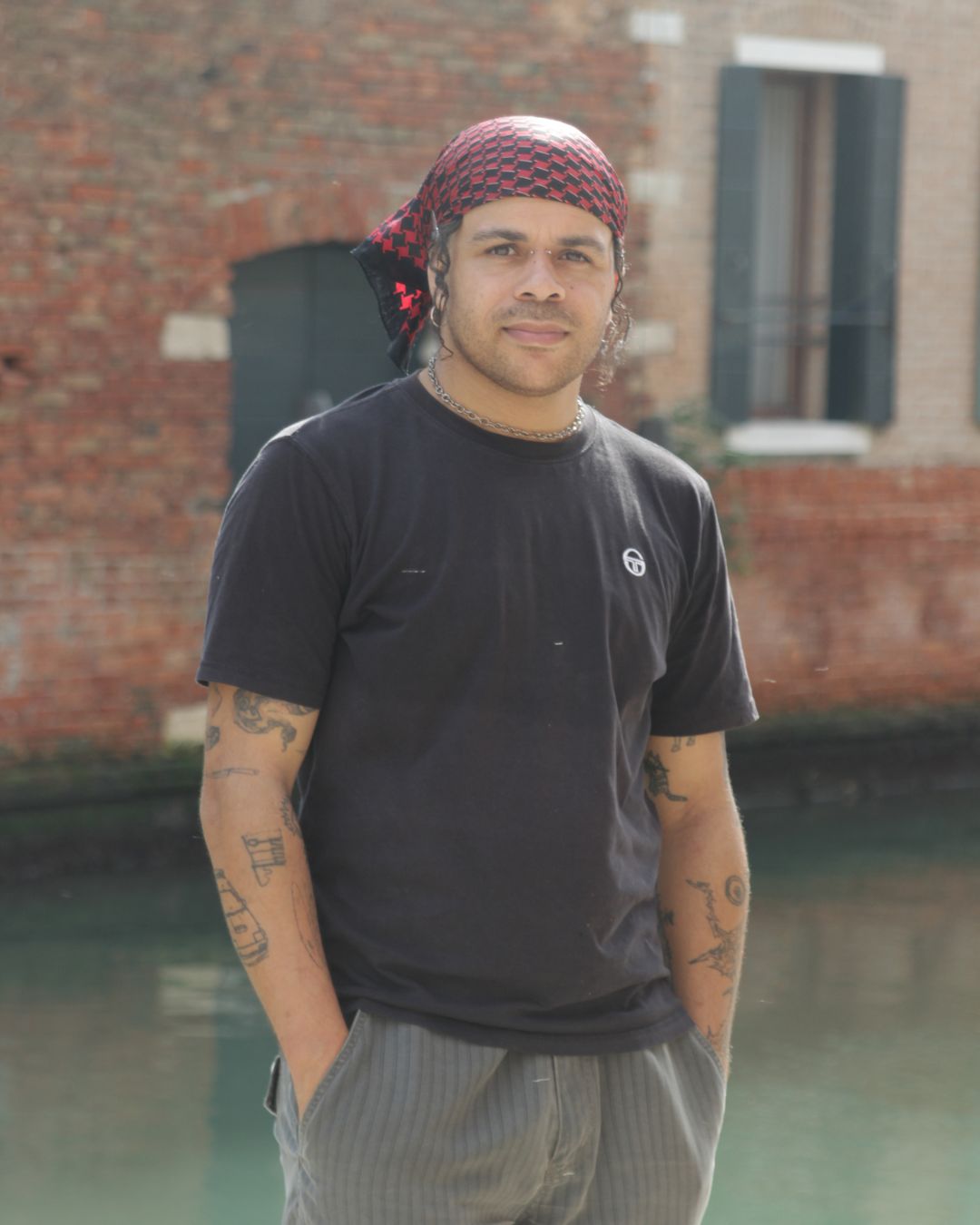
Portrait by Maria Anita Pozzi
terzospazio
Your artistic practice connects archaic imagery with technological futures, creating hybrid installations that oscillate between ritual and anticipation. How would you define your research, and what are its main roots?
Joshua Leterreux
My research takes a post-futurist perspective that aims to break free from capitalist logic, while examining specific contexts through the use of the archives – conceived as both an end in themselves, a key to understanding, and a space for autonomous knowledge. I question the gradual loss of technical and intellectual exclusivity, and in this sense I develop a range of archiving methods – digital, material, organic, collective – that serve both to safeguard and conceal knowledge, sometimes in opposition to accelerationism and the imperatives of state and corporate control. The possibility of concealing or diverting this knowledge then becomes central, opening up a space for resistance and counter-society.
Speculative archaeology refers to a practice that is both forward-looking and critical: it involves imagining how our objects, traces and protocols, here for transmitting knowledge will be interpreted, reused or repurposed in the distant future, especially in a post-post-apocalyptic or near future world. Through projection, my approach allows me to recontextualise and re-evaluate the value, use and memory of everyday artefacts, while conjuring up new narratives around the forgetting, appropriation or marginalisation of knowledge. This hypothetical diversion shifts my perception and that of the viewer, inviting them to think of collective memory not as a given, but as a fragile, malleable construction that is sometimes concealed out of necessity.
Thus, my installations materialise hybrid forms of memory and archives, playing on the plurality of media and access. They question transmission, erasure and preservation – issues that resonate particularly strongly with marginalized communities (racialised, LGBT, migrant or from colonised countries), who are often forced to invent specific strategies to preserve their knowledge. In this approach, transmission becomes a political and speculative act, essential to the survival of legacies in an Anthropocene context where control of the future depends closely on the vitality of memory.
TS
Your research often takes the form of installations and collective initiatives that go beyond the limits of the canonical exhibition space, pushing to the margins of the urban environment. terzospazio also places the collective exploration of peripheral spaces at the center of many of its proposals, in an attempt to generate shared reflections based on curiosity about open, unusual, but meaningful places. How does your research engage with the collective dimension and the possibility of generating situated and shared knowledge?
JL
My research finds its full dimension in collective dynamics, particularly in the way that exhibitions are staged outside institutional frameworks. The reappropriation of non-dedicated spaces – or ‘off-site’ spaces – is linked to a desire for digital autonomy, whether through dedicated web platforms or international research networks. On a collective level, my involvement translates into the creation of independent spaces for reflection and experimentation, both digital and physical. The development of joint curatorial proposals, based on the intersection of each person's research, is an effective tool for developing collective thinking over the long term. I have found particular inspiration in the energy of Marseille's collectives, which bring together artistic practices and activist commitments. In my opinion, this provides a valuable framework for pooling, structuring and transmitting diverse and committed knowledge.
TS
Speaking about Mastic Collective, how did it come about, what was the need behind it? Can this experience be seen as a response to the structural fragility of the art system?
JL
Mastic was created in the summer of 2021, following the graduation of several members of the collective, with the initial ambition of coming together to create a shared workspace and to help each other collectively during the difficult period following the end of their studies. This initiative is a direct response to the fragility of the arts system, particularly its limited support from state and city-level institutions. In Marseille, accessible workspaces, whether public or private, remain rare, prompting many artists to organise collectively. In response to the lack of access to venues, Mastic (now with 18 members) spent almost three years searching for a space to work collectively and opened Sili in February 2024, a space used by 32 art workers. Being at the heart of this complex context has enabled us to equip ourselves with the necessary tools to understand and confront the realities we face. Mastic thus embodies a collective and practical response to these challenges, promoting the pooling of resources and skills in an environment where solidarity becomes an essential lever for the survival and sustainability of artistic practices.
TS
Thinking about the concept of the third space (Bhabha, Clément), which for us indicates a laboratory of social imagination, an intermediate place of reappropriation, a cultural experiment outside institutional logic, do you think it is a term that we could potentially apply to Mastic as well?
JL
Yes, absolutely. However, the idea of a third place is embodied more by the Sili project, our space, than by the use of Mastic itself, even though our internal functioning is inspired by many similar places and collectives. In particular, through a horizontal system, the creation of autonomous decision-making colleges and permanent copyleft. Even though, at their most intense periods, our community commitments often took precedence over all other aspects of our lives, whether artistic or professional, I keep thinking about this space and collective, as well as the future we can build together there, because there are many projects and ideas to be explored with a structure such as this.
TS
Beyond artistic production, do you think Mastic's activities can be seen as opportunities for self-education and for building new ways of bringing together art, technology, and community?
JL
The general idea behind Mastic and Sili is rooted in this possibility. When creating the space, we emphasised the contemporary artistic dimension. In the future, with various projects in the pipeline, it is not impossible that our space could take on a different role, focusing on education, craftsmanship and self-sufficiency (which are already part of the work of many people in the space). This environment can be used in many ways, as a community or militant gathering place, at least I hope so!
TS
What relationship does Mastic have with institutions?
JL
The French system is a little different from the Italian system in terms of institutions and funding, but we run in parallel, I would say. Our operations and access to resources (economic, space, equipment) are completely autonomous. But over time, bridges and exchanges are being built. From my point of view, this is something I notice overall: a large proportion of collectives interact much more with institutions, but this does not necessarily imply financial or other assistance. This year, we received a grant from the regional department, which enabled us to carry out a lot of work, create dedicated creative spaces and support the installation of new artists. We hope to obtain new resources to enable us to offer some form of partial remuneration.
TS
What does the independent art scene in Marseille look like today?
TS
Ooooh, there's so much to say. I would say that one of the great strengths of Marseille's independent scene lies in its deep roots in activist circles. Marseille, through its geographical position and history, exerts a significant influence on the Mediterranean basin, which is marked by issues of precariousness, migration and interculturality. Its place on the national scene, while remaining close to Paris, gives it an autonomous, very punk and independent vibe, which does not seek to model itself on institutions or galleries — or at least does not shy away from distancing itself from them, or even creating around them. The independent scene is tacitly linked and permeable: there are many collectives, spaces and projects that intersect through their members, curators or joint initiatives. This porosity creates a living and collaborative fabric. In recent years, thanks to the creation of numerous independent collective workspaces, this new scene has been able to truly organise itself, experiment and propose committed projects that contribute to its cohesion. I am thinking in particular of collectives and spaces such as Sulfur, Atelier Panthera, Châteaux Faibles, 6b éditions and Agent Troublant, for example.
TS
How do you think the dialogue with the reality of Venice, understood both as a place and as a community of affections, can interact with your artistic practice? Is there any theme, attitude, or concept that you think could guide your intentions during the residency?
JL
This is a complex question, and I think I will be able to give a more complete answer at the end of the residency! But after some time in Venice, I have noticed many similarities in the way the art scenes in both cities operate, particularly in terms of autonomy and collaboration within collectives. The Come Come network particularly inspired me, representing a model of cooperation that several organisations in Marseille aspire to develop, beyond the occasional collaborations often limited to contemporary art festivals. I was quite impressed by the close link between the independent and institutional scenes, which seem to be very intertwined. This space has a physicality and existence of its own with nature that fascinates me deeply. I am eager to discover this aspect too, as I have heard a lot about the surrounding rivers and want to discover Venice by water and by boat to understand how it works. With all that said, I intend to make use of the local and obsolete resources that I plan to gather, and we will see what comes of it.